
5 Things You Might Not Know About Health Simulation at UNH

When many people hear "simulation center," they picture nursing students practicing on mannikins in a hospital-style setting.
At the University of New Hampshire's Health Sciences Simulation Center (HSSC), that image only tells part of the story.
Students across multiple disciplines use simulation to practice clinical skills, communication, teamwork, and decision-making through experiences that range from virtual reality & AI patient encounters to home-care assessments and emergency response training. Some simulations take place inside the center. Others happen in classrooms, clinics, and settings across campus.
"Simulation is really about experiential learning," says Marguerite Corvini, director of simulation. "It gives students a safe place to practice, make mistakes, and reflect before they encounter these situations in real life."
Here are five things you might not know about simulation at UNH:
The Simulation Center Isn’t Just for Nursing Students
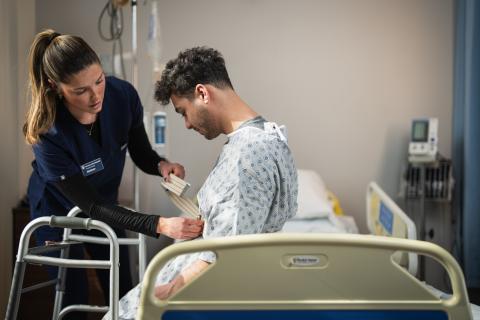
While nursing remains one of the largest users of the simulation center, Corvini says nearly every discipline in the UNH College of Health and Human Services (CHHS) can benefit from simulation-based learning.
Occupational therapy, speech-language pathology, health sciences, and social work students all participate in simulation experiences tailored to their professions. Those experiences can range from neonatal care and healthy aging scenarios to communication-focused exercises and patient/client assessments.
As more faculty discover ways simulation can support their courses, Corvini says simulation center staff can help customize experiences.
“If you can dream it, we can build it,” Corvini says. “We have the team and the expertise to provide a structured simulation.”
Simulation is More Than a Building
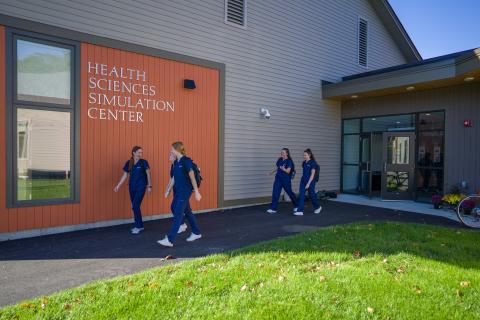
Not every simulation takes place inside the simulation center.
"The simulation center is more than a building. It's a team of simulation experts who can bring meaningful learning experiences wherever they're needed,” Corvini says. “The space is great, and we need it, but simulation doesn't have to happen within these walls."
That flexibility allows simulations to take place in a variety of settings. A social work scenario might happen in a home environment. A kinesiology simulation could take place in a cardiac rehabilitation setting. Community partners may train in spaces that mirror the environments where they actually work.
To support that vision, the center is expanding a home-care simulation environment in Hewitt Hall that will allow students to practice skills in a setting that feels more like a real residence than a hospital room.
“We want everyone to think more broadly about what simulation can do to expand experiential learning opportunities for students,” Corvini says.
Students Learn How to Work Across Disciplines
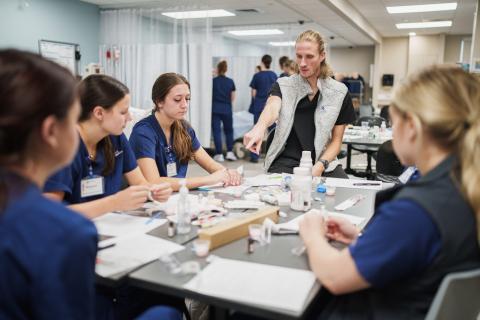
Healthcare professionals rarely work alone.
Nurses, occupational therapists, speech-language pathologists, social workers, nutrition specialists and other providers must communicate effectively to deliver quality care.
A recent interprofessional simulation involved students working through a stroke scenario. Nursing and occupational therapy students conducted assessments together, while speech therapy and nutrition students also evaluated the patient's needs.
The simulation included AI-powered interactions with the patient and family members in a home setting, allowing students to consider recovery, safety, and care planning from multiple professional perspectives.
"Simulation breaks down silos and gives students an opportunity to practice working together before they encounter those situations in the real world,” Corvini says. "The learning really happens during the debrief. It's about reflecting on the experience and thinking about what you learned."
Manikins Are Only One Part of the Experience

The center's high-technology manikins can do some remarkable things.
Some can talk, cry, cough, display pulses, receive IVs, and even simulate childbirth. Others are designed specifically for pediatric, neonatal, and critical-care scenarios.
But simulation goes well beyond manikins.
The center also uses virtual reality technology, AI-powered patient interactions, and a growing standardized patient program that employs trained actors to portray patients and family members. One recent example included an actor playing the role of a dying patient during an end-of-life simulation.
For students, the goal is realism. Whether they are speaking with an AI-generated patient recovering from a stroke at home or interacting with an actor portraying a client in crisis, simulation provides an opportunity to practice skills in a safe environment before encountering similar situations in the field, according to Corvini.
The Simulation Center Supports Community Training

Simulation isn't just for students.
The HSSC partners with local EMTs, firefighters, and healthcare organizations to provide workforce training and professional development opportunities.
Recent simulations have focused on neonatal emergencies, obstetric care, and overdose response—areas that are especially important in rural communities where specialized healthcare resources may be limited.
"Our first responder partners are increasingly encountering these situations that require specialized skills, and we’re able to provide that training,” Corvini says.
The center has also worked with law enforcement on stress reduction training and trauma response, and long-term care facilities on fall prevention, end of life, palliative care, and compassionate communication.