
Can northern forests continue to be an effective carbon sink?
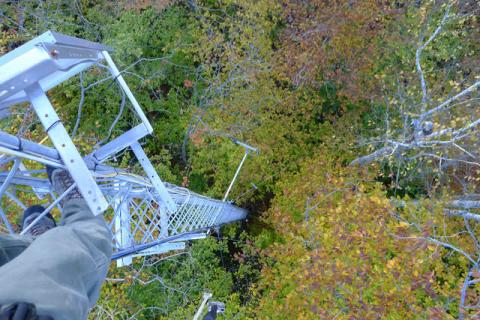
Researchers record measurements high above the canopy in Bartlett Experimental Forest. (Photo courtesy of Northern Arizona University)
Forests have played a vital role in a changing world by removing carbon dioxide from the atmosphere and storing it in trees and soil. But a new study conducted in the Bartlett Experimental Forest, located just west of Conway, New Hampshire, found that its ability to absorb more CO₂ than it releases has declined over the last 20 years. Moving forward, just how much we can rely on these forests to help slow the accumulation of carbon in the atmosphere?
The research team, led by Andrew Richardson, a professor at Northern Arizona University and former postdoctoral associate at UNH, and Darby Bergl, a doctoral student at NAU, and including New Hampshire Agricultural Experiment Station scientist Scott Ollinger, professor of natural resources and the environment at UNH, took advantage of an exceptionally rare 20-year record of measurements taken at Bartlett to ask a simple question: Are temperate forests continuing to absorb carbon dioxide from the atmosphere as expected? They found that the answer — at least at this site — was, increasingly, no. Their findings were published in Global Change Biology Communications.
Between 2004 and 2023, the research team found that the carbon sink strength of Bartlett, a mature forest that has been extensively studied since its establishment by the USDA Forest Service in 1931, declined substantially. The decline was not caused by a reduction in photosynthesis or wood growth, as the researchers had expected. Instead, it was driven by increasing carbon release from the ecosystem through respiration, the natural process by which plants, roots, and soil microbes emit carbon dioxide.
“Over that time period, there’s been a steep decline in the amount of carbon dioxide the forest sequesters annually, and a primary cause seems to be warming winter temperatures,” says Ollinger, who is also on the faculty of the Earth Systems Research Center. “Long-term observations like these are critical for understanding whether forests can continue to provide one of nature's most important defenses against rising atmospheric carbon dioxide.”
In several recent years, the forest even became a net source of carbon rather than a sink.
"We often think of forests as one of our best natural climate solutions because they remove large amounts of carbon dioxide from the atmosphere, so changes in their ability to store carbon could have important consequences,” says Bergl. “Our findings suggest that mature temperate deciduous forests may no longer reliably remove more carbon than they release under continued global change.”