Connecting Communities to the Outdoors

Recreation has been important for Plymouth, New Hampshire for more than a century. Waterways and mountains make it a destination for anyone looking to hike, fish, paddle, mountain bike, rock climb, or otherwise surround themselves with the natural world.
But in Plymouth, as is so often the case, officials struggle at times with how to leverage their outdoor resources for the economic benefit of the town.
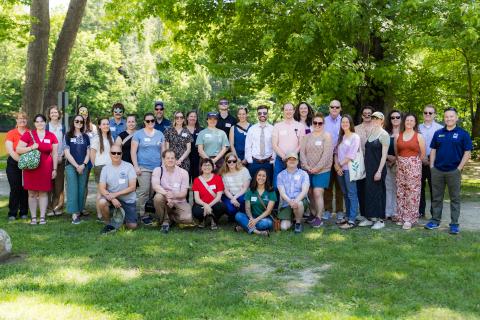
That’s one of the reasons why the Outdoor Economy Academy spent a day in Plymouth this summer. The academy, a program offered by UNH Extension’s Community and Economic Development team in partnership with NH Business and Economic Affairs Outdoor Recreation Industry Development’s Director Janel Lawton, spent the day meeting with town planners, municipal department leaders and businesspeople to discuss the opportunities, challenges and solutions to making outdoor recreation a central plank of economic development.
Many communities have already started to realize this potential. Outdoor recreation in 2024 contributed $4.2 billion to the state’s economy, and supported more than 33,000 jobs, according to the U.S. Bureau of Economic Analysis Outdoor Recreation Satellite Account.
Collaboration and Conversation
Avery Opland, who works in the planning department in Plymouth, joined the group walking through Plymouth. She says that the built infrastructure can prevent humans from accessing natural resources. In Plymouth, Opland notes, the Pemigewasset River parallels Main Street but can’t be easily accessed by foot.
From the Town Common, pedestrians can access Riverside Park, with its amphitheater, kayak launch and walking trails, by walking down Green Street. But that street, though short, is fairly steep, has no sidewalk, and there's nothing to divide vehicle traffic from walkers. This example shows, says Opland, that for a town to make the most of their outdoor recreation economy, departments that wouldn’t normally worry about accessing nature, such as the highway department, should be brought into the discussion.
“You’re all part of one community, and communities only function when they work together,” she says.
Some barriers might even be invisible, says Academy participant Brittany Carr, who works in Barrington’s Parks and Recreation Department. “I lead a lot of experiences out in nature and I feel like a lot of people don’t feel comfortable going out on their own,” Carr says.
People can be nervous about getting lost, swarms of bugs, or animals. But, she’s found, familiarity is the cure. Offer guided group excursions to an area, and those who come will feel more comfortable returning by themselves.
There are solutions that Barrington hasn’t yet found on its own, though, so Carr was all ears at the Academy. In fact, she found that one of the most valuable benefits of the Academy was access to the other participants.
“It’s the resources, the connections, where people have answers to things or experiences that we haven’t experienced,” she notes. “We’re growing and I think that learning from other people who are a few steps ahead is really helpful.”
Calling All Champions
Anna Stockman ’20, ‘26G works for the Somersworth Planning Department, a city that sees opportunity in its natural spaces.
“There’s a committee that’s looking into a river walk to connect residences and local trails to the downtown,” Stockman says, adding that she’s been listening for tips to help make such projects more successful. One such tip is the need for ideas to have a champion, someone who can pull together disparate interest groups. Broad support not only brings an idea to reality, it also translates to sustained support once the amenity is built.
“I think the community would benefit from looking at these programs that have been successful in other communities and replicating that,” Stockman says.
The same point struck home for Julia Novak Colwell, a senior lecturer in UNH’s Department of Natural Resources and the Environment. She attended the Academy to collect local examples to bring back to her students.
“One thing that I’ve been noticing is how much this work, which we talk about in a broad, kind of macro sense, happens at a very micro level,” Novak Colwell says. “Every successful project, whether it’s a small-scale project like replacing a culvert, or something wider or larger scale, has a good plan and a champion. I teach a leadership for sustainability class, and coming into this next semester, I’m going to integrate those concepts much more foundationally into the class.”
Natural amenities can become a kind of “third space,” as Novak Colwell calls them, places that are neither a home nor place of employment. “These third spaces allow us an opportunity to build community, which makes communities stronger.”
“I am very impressed with what UNH Extension is doing here,” continues Novak Colwell. “This has been a highly effective workshop. It’s brought together people from all different areas of New Hampshire and all different roles, and served to connect people. I’m really glad to have been a part of this.”
The Academy engaged 23 professionals and volunteers from 18 communities and organizations across the state. Shannon Rogers, Extension professor and state specialist of nature-based economic development, said the program was developed for those “working at the intersection of nature and the economy. There is high demand in this space as NH’s outdoor economy grows.”
Rogers, who is planning follow-up programming, says, “It’s been a fantastic pilot program with inspiring participants who are already beginning to implement new ideas and projects in their communities.”