
Research That Makes the Granite State Great

It’s right there in the name — the University of New Hampshire — and in our mission. With Land, Sea, and Space Grant designations, UNH commits to producing and sharing research grounded in solutions that make life better for Granite Staters. Here are some powerful ways UNH faculty, students, and staff are tackling some of New Hampshire’s most pressing issues.
Safe swimming

At New Hampshire’s ocean beaches, UNH is tracking white sharks to assure millions of visitors that yes, it is safe to go back in the water. Researcher Nathan Furey has partnered with the town of Hampton for the past few summers to place acoustic receivers in the ocean to monitor local shark activity.
“Every summer we do detect a handful of sharks, but one of the things we’ve learned is they don’t tend to hang out very long – we only tend to detect them for up to 10, 20, 30 minutes,” Furey, associate professor of biological sciences, says. “To me that implies that they are largely just swimming by.”
UNH’s collaboration with Hampton has proven to be a mutually beneficial arrangement for swimmers and sharks alike. “It’s been an outstanding partnership,” Patrick Murphy, chief of New Hampshire State Beach Patrol, says of the connection with UNH. “It’s about how do we make people’s day at the beach safer, along with how do we keep ecosystems running how they should be?”
Cracking Cold Cases

To solve a mystery almost four decades old, New Hampshire officials tapped student and faculty researchers in UNH’s Forensic Anthropology Identification and Recovery (FAIR) Lab.
Led by Amy Michael, a biological anthropologist and assistant professor of anthropology, the FAIR Lab partnered with the DNA Doe Project to assist the state’s Office of the Medical Examiner in analyzing unidentified human remains found in Bristol, New Hampshire, in 1986 and ultimately giving those remains a name: Warren Kuchinsky, born in 1952 and last known to be alive in the 1970s.
The FAIR Lab has contributed to several cold cases in recent years, including helping with the recovery of the remains of Alberta Leeman, who went missing from her Gorham, New Hampshire, home in 1978. Students, says Michael, are directly involved in the cold case work.
“As a professor, it's rewarding for me to see students develop technical skills alongside a deep appreciation for, and acknowledgement of, the need for human identification in historic and modern cases,” says Michael.
Hunting Forever Chemicals
Paula Mouser hangs out at wastewater facilities, so you don’t have to.

Mouser, professor of civil and environmental engineering, is on the hunt for PFAS across the Seacoast, with the goal of identifying where they come from and mitigating their impact to keep our water — and us — healthy. Called “forever chemicals” because of their staying power and health risks, PFAS (per- and poly-fluoroalkyl substances) enter our drinking water through wastewater and runoff.
“Communities in New Hampshire are working hard to eliminate PFAS from their drinking water and wastewater systems through source reduction and novel water treatment technologies,” she says. “But we still have much to learn about how these compounds move and where they are ending up in the environment.”
The Great Outdoors, Great for All
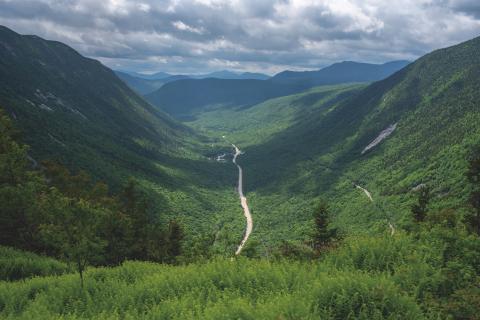
Each year, six million people visit New Hampshire’s White Mountain National Forest to hike, ski, leaf-peep, camp, and enjoy its rugged peaks and scenic vistas. That’s more visitors than either Yosemite or Yellowstone national parks, and they’re a significant driver of the state’s $4 billion outdoor recreation economy.
To better understand who’s coming to the White Mountain National Forest (WMNF), what they’re doing, where they’re spending money, and what they need, the USDA Forest Service turns to UNH. For more than a decade, researcher Mike Ferguson has partnered with the Forest Service to collect visitor data that informs decisions around staffing, trail maintenance, infrastructure investments like signage — and ultimately allocation of federal dollars.
It’s research “that truly drives decisions impacting people across the state,” says Ferguson, associate professor of recreation management and policy. “It influences everything from outfitter guides and retail sales to local restaurants and the broader regional economy.”
Protecting Our Lakes
Lake life. In New Hampshire, it’s not just a vibe; it’s big business, attracting millions of visitors and seasonal residents to the state each year. While factors like development and a changing climate make keeping those lakes clean more challenging, 120 of them have a secret weapon: UNH’s Lakes Lay Monitoring program.

Since its founding in 1979, the UNH Extension effort has trained and engaged more than 1,000 citizen-volunteers — often homeowners on those lakes — to monitor lake health. These volunteers work alongside Extension staff, researchers, and UNH students to regularly sample lakes for temperature, transparency, and more complex chemistry.
As increasing pressures from human activities threaten the health of lakes, volunteers are a force-multiplier of lake health, providing essential on-the-ground insights to UNH scientists. And the Lakes Lay Monitoring Program, in turn, can tap decades of historical data to help lake associations manage those resources for future generations.
“You can really protect the lake by just knowing a little bit about it,” says program director Amanda McQuaid.
Keeping Us Healthy
If you or a loved one gives birth, suffers a cardiac emergency, or seeks care for a mental health crisis, crunching data is far from your mind.
But data — who’s paying for care? How long are they staying in the emergency room? How quickly and completely do they recover? — is at the root of high-quality health care. To analyze that data and inform policy and practice, the state of New Hampshire often turns to UNH’s Institute for Health Policy and Practice.
The institute has a unique agreement with state government to support many technical assistance and applied research needs in collaboration with various programs for the state. As such, the institute provides far more than data analysis and policy recommendations: It offers trainings, convenes practitioners and agencies to promote best practices, and even hosts the state’s maternal and child health epidemiologist.
Federal Funding, Local Impact
Federal research funding to UNH produces a lot more than knowledge. For every $100 in federal funding, UNH generates an additional $77 in economic activity, according to a recent report.
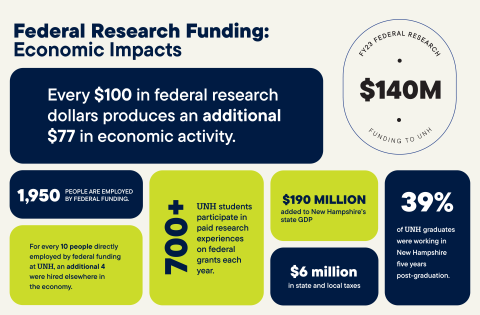
In fiscal year 2023, federal research funding to UNH, which was more than $140 million, added $190 million to New Hampshire’s state gross domestic product and generated $6 million in state and local taxes.
Additional impacts of UNH research funding include:
1,950 people are employed by federal funding.
700+ UNH students participate in paid research experiences on federal grants each year.
For every 10 people directly employed by federal funding at UNH, an additional four were hired elsewhere in the economy.
39% of UNH graduates were working in New Hampshire five years post- graduation.