
UNH Marks Jackson Estuarine Laboratory Expansion at Ribbon Cutting
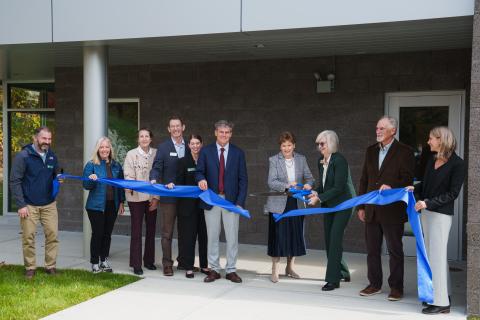
U.S. Senator Jeanne Shaheen (with scissors) cuts the ribbon on UNH’s Jackson Estuarine Laboratory expansion with School of Marine Science and Ocean Engineering Director Erik Chapman (to her right), UNH President Elizabeth Chilton (to her left), Jackson Estuarine Laboratory Director David Burdick (to Chilton's left), and state and community partners.
New Hampshire’s estuaries and coastal economies are about to get even healthier, thanks to a major expansion at UNH’s Jackson Estuarine Laboratory on Great Bay.
At a ribbon-cutting ceremony Oct. 26, 2026, U.S. Senator Jeanne Shaheen joined UNH and state leaders to celebrate the completion of the project, which added 4,500 square feet of enhanced facilities for studying estuaries.
“The work done at the University of New Hampshire’s Jackson Estuarine Laboratory has been indispensable in advancing critical research that allows us to better understand our coastal ecosystems in New Hampshire and around the world,” says Shaheen. “I was proud to help secure over $3 million in federal funding to improve the state-of-the-art lab and ensure it has the resources it needs to continue its groundbreaking work, and it was great to see the facility improvements behind this project earlier today. I know this upgraded facility will lead to new breakthroughs for building resiliency in our estuarine and coastal systems. I can’t wait to see all that lies ahead.”
“Marine science and sustainability are longstanding strengths at UNH, and we're committed to building on that expertise to make an even greater impact in New Hampshire and beyond. This expansion represents an important investment in that work,” says UNH President Elizabeth Chilton. “Just as importantly, we're creating new opportunities for students to work alongside experienced scientists and gain hands-on experience addressing real-world challenges.”
Updated Facilities for Elevated Capacity
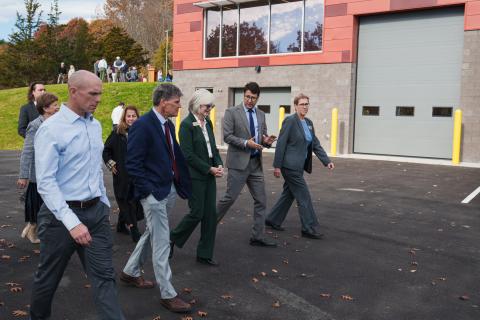
Visitors to Jackson Estuarine Laboratory tour the new facility, including its high bay.
Among the features of the Jackson Estuarine Laboratory (JEL) expansion:
Two high bays for working on vessels, buoys, and equipment for aquaculture and remote sensing;
Dive lockers with showers and space for storage and repair of SCUBA equipment;
A 36-person meeting room with an adjacent office;
A new entryway to the facility.
“This project modernizes and expands UNH’s nearly 60-year-old laboratory on New Hampshire’s Great Bay, elevating UNH's capacity for estuarine research, teaching, and public service,” says Erik Chapman, director of UNH’s School of Marine Science and Ocean Engineering and N.H. Sea Grant. “Research and monitoring focused on water quality, environmental toxins, habitat restoration, and aquaculture deliver direct economic and quality-of-life benefits for Granite Staters.”
JEL will also serve as the permanent home of the Piscataqua Region Estuaries Partnership and will host community partners and collaborators — including N.H. Fish and Game, N.H. Department of Environmental Services, The Nature Conservancy N.H., and the Northeastern Regional Association of Coastal Ocean Observing Systems (NERACOOS) — in dedicated space. A new minivan will increase access for collaborators and for UNH students in a range of disciplines.
A second phase of the project will involve renovations and updates to the original building.
First of Its Kind
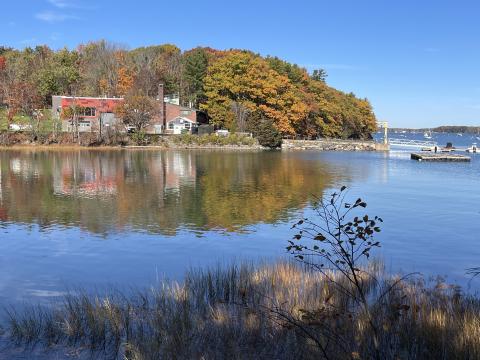
Built in 1970 and located on Great Bay in Durham, five miles from the UNH campus, JEL was the one of the nation’s first academic labs dedicated solely to studying estuaries. Research at the lab helps understand, protect, and manage New Hampshire’s estuaries — Great Bay, sometimes called New Hampshire’s “hidden coastline,” and the Hampton-Seabrook estuary — and advances the state’s coastal economy. Research at JEL, spanning oysters, lobsters, horseshoe crabs, eelgrass, and more, has improved our understanding of coastal ecosystems, environmental quality, and the connection between watershed and human health.
Estuaries, partially enclosed bodies of brackish water where rivers meet the ocean, are among the most productive habitats on Earth. They provide sheltered spawning and feeding grounds and are habitat for nearly 70 percent of the U.S. commercial fish catch, and they absorb flood water and mitigate the effects of storms to protect property.
Total cost for the Jackson Estuarine Laboratory expansion is estimated to be $5.2 million. Funding for the project is from the National Institute of Standards and Technology (NIST), with additional funding from UNH. The Turner Group (Concord) were architects and engineers, Tighe & Bond (Portsmouth) provided civil engineering, and Milestone Construction (Concord) managed construction.