
UNH Students Nominated for Marshall, Rhodes Scholarships
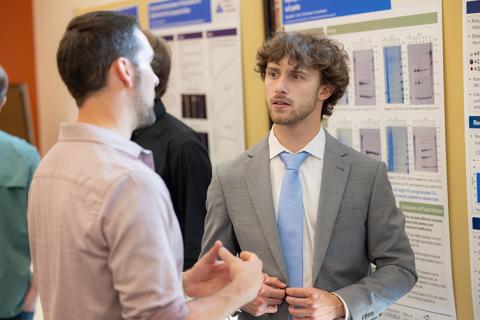
Will Steere ’27.
UNH students Will Steere ’27 and Eben Quenneville ’27 were nominated for 2026 Marshall scholarships, with Quenneville also earning an endorsement for a 2026 Rhodes scholarship. Marshall and Rhodes scholarships are two of the most prestigious and competitive awards available to U.S. students.
Steere learned this week that he is a finalist for the Marshall opportunity and will have an interview upcoming. Quenneville was not selected as a finalist for either honor.
The Rhodes scholarship provides support for students to study at the University of Oxford and is the “oldest and most celebrated” international postgraduate award, according to the Rhodes website. Marshall scholarships offer 1-to-3 years of post-graduate study to students pursuing a graduate degree in the United Kingdom. Recipients can study in virtually any field at a UK institution of their choice.
“Being nominated by UNH for the Marshall Scholarship is an exciting recognition for progressing toward this national award. It feels special to have passed the interview process and earned a nomination by UNH, and I am hopeful that I can win this scholarship and bring recognition to UNH and CEPS,” Steere says.
Adds Quenneville: “It's an extraordinary privilege to have so many wonderful mentors at UNH and beyond. When I arrived at UNH, I certainly wasn't imagining that I would one day be applying for scholarships like the Rhodes and Marshall. But over the past few years, I've had opportunities to contribute to exciting scientific research, help launch a satellite, work with researchers around the world, and make a meaningful difference in physics education on campus. Those experiences, and the encouragement of the people I've worked with, have given me the confidence to pursue opportunities that once seemed out of reach.”
Steere, a chemical engineering honors student, earned first place for his presentation on catalytic biomass valorization research at UNH’s Undergraduate Research Conference during his junior year, an achievement he includes among his proudest as a student. He also earned an internship at the National Laboratory of the Rockies in Golden, Colorado, which he described as “one of the most impactful experiences I have had.”
“I connected with top researchers in my field and learned about the operations of the US Department of Energy, but I also led a high-level research project tied to the Genesis mission aiming to make progress toward AI-driven research laboratories for catalysis,” Steere says.
Steere hopes to earn a Ph.D. in chemical engineering “to transfer my research in catalysis into impactful commercial processes.” He is interested in founding a startup based off the catalytic technology he plans to develop during his Ph.D. work or in joining a research institute like a national laboratory in the United States or somewhere global.
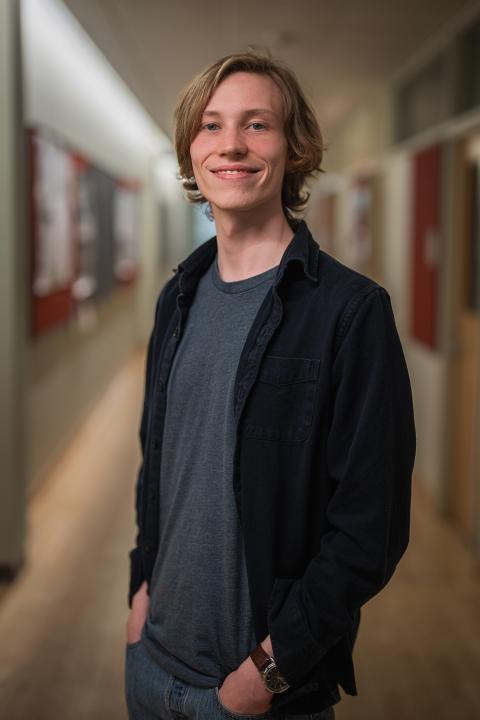
Eben Quenneville ’27
Quenneville, an engineering physics honors student, counts his work improving physics education for other students at UNH among his proudest achievements since arriving on campus. He has been involved in the Physics Learning Assistant program since his first semester, an offering that places undergraduates in introductory physics classrooms to help their peers work through problems and overcome conceptual hurdles, he says.
“It’s tremendously rewarding to help other students develop their understanding of physics,” Quenneville says. “Teaching also forces you to understand the material more deeply yourself, and I think that experience has been invaluable to my own success in research and advanced coursework.”
He has also worked with Alec Mercer ’26 and Benjamin Chandran, professor in the College of Engineering and Physical Sciences, to overhaul UNH’s physics tutoring center, now known as the Physics Assistance and Resource Center (PARC).
Quenneville has pursued a variety of research as a student (he earned the Barry Goldwater scholarship in recognition of that research), most recently partnering with Chandran and Jonathan Squire from the University of Otago in New Zealand to better understand solar wind. He also helped develop and launch 3UCubed, a satellite “about the size of a loaf of bread” that was part of NASA’s IMAP student collaboration.
Quenneville’s career goal is to become a professor of plasma physics, a pursuit “that would allow me to combine my two great interests: teaching and research.” He credited the “wonderful people” at UNH’s Office of National Fellowships, who have played a key role in facilitating the Marshall and Rhodes opportunities as well as a host of others throughout his time at UNH, including the NSF Graduate Research Fellowship and a Fulbright.