
Unlocking the Outdoors
Everyone should be able to take a stroll — or a roll — through the woods in New Hampshire, believe the folks behind the website Trail Finder. For those who have ability limitations, though, starting down a trail can be a gamble, as it’s hard to know exactly what kind of terrain is around the next bend.
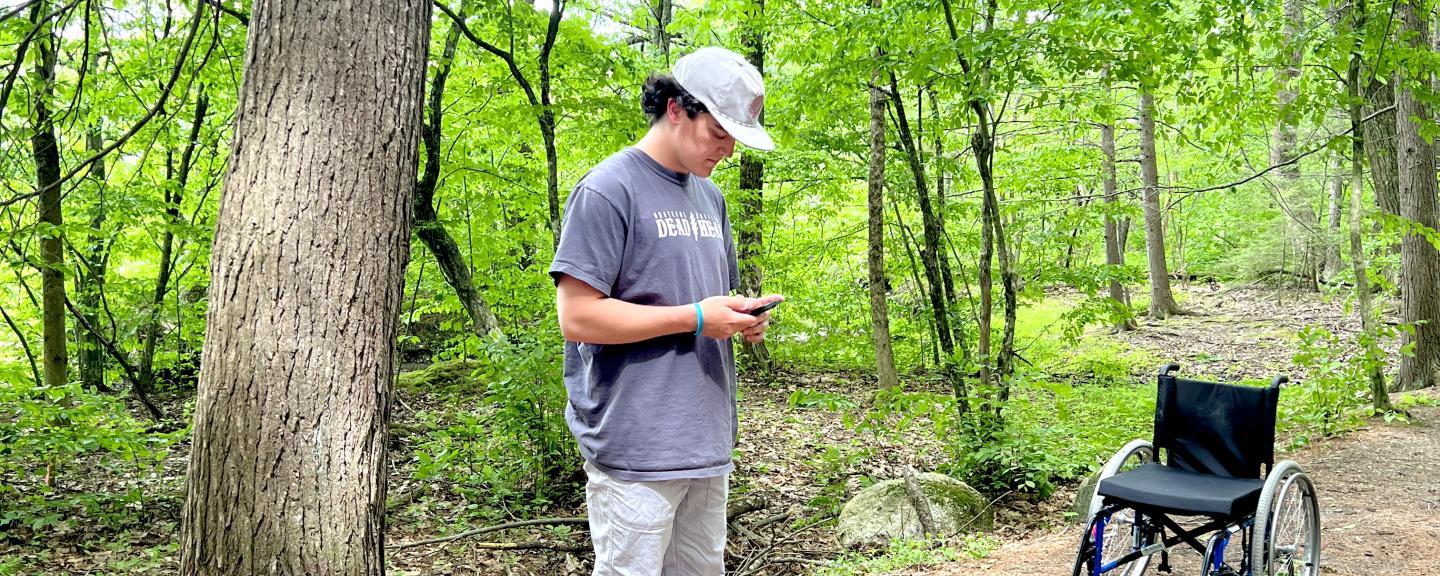
The odds are turning in their favor, thanks to a partnership between UNH Extension and Trail Finder. As a result of that partnership, Brendan Thornton ’27 spent his summer surveying and documenting the accessibility of trails throughout the state. Thornton gathered data on 29 trails this year, bringing the total number of surveyed trails to 56 so far.
Trail Finder’s effort to make trails more welcoming to more people began several years ago, when they added the ability for trails to be marked as “accessible.” That was a solution that invited more questions than it answered, they found.
The problem with the initial strategy used by Trail Finder’s designers, said Stephen Engle, executive director of Community Geographics, a digital mapping technology company that joined with Extension and the Upper Valley Trails Alliance to create the platform in 2010, was that it used a simplistic approach to accessibility. In that first attempt, a trail network was considered either accessible or not, and it was left up to the trail owner or manager to make the call.
Results were uneven at best, Engle says. A trail might be listed as accessible even though there was a curb between the parking lot and trail head. Or, in other cases, a largely accessible network was not marked as such because the trail manager felt uncertain.
“On the whole, we felt that Trail Finder wasn’t doing the best job in helping users find trails to meet their ability,” says Engle. They needed a new approach, one that leans into the quirks and features of each individual trail. Each trail has its own aspects of accessibility, such as incline, trail surface, and restroom facilities. Each hiker has their unique physical limitations, and a trail that’s accessible to one person might be hazardous for someone else. “Everybody has their own perception. There are differing interpretations of what accessible means.”
Empowering Information
When talking about barriers to trail access, says UNH Extension Specialist Emma Tutein, a lack of information might be the first hurdle.
“Where is the trail, what is it like, how do we even get to it?” Tutein says. “For a lot of people, they want to know. And that becomes more important if you have a disability.”
The problem is, gathering all that data takes time and expertise. A solution was found in 2025 when a UNH student, interning with Extension, spent his summer examining trails for their surface material, width, degree of incline, cross-slope, and amenities such as benches and accessible restrooms. The NH Charitable Foundation provides funding for the project.
This summer, that cache of information doubled in size, thanks to the efforts of Brendan Thornton ’27, an environmental conservation and sustainability major who has been exploring New Hampshire woods since he was a toddler. “This job is cool because I get to use my love for nature and the outdoors ,” Thornton says, “and apply my skills to helping people who might not have the same opportunities as me.”

Brendan Thornton '27
One of Thornton’s relatives has Down syndrome, so he already understood the importance of inclusion. Working on the trail project gave him new insight, however. He was studying a trail in North Conway when a man stopped and told him about his wife, who has trouble navigating certain trails due to nerve damage, although her disability is invisible to most.
“Knowing that I’m helping people like that is pretty cool,” Thornton says. “It’s definitely something I think about when I’m out there.”
Dispelling the Barriers
Engle says that people with disabilities are used to encountering physical barriers, but sometimes informational barriers are the hardest to overcome. No one wants to make it halfway down a trail only to find an unexpected stream crossing, gate or boulder blocking their progress.
“One of the most important things for us to understand is that having detailed information about trails benefits everyone. But we haven’t taken the time to curate our trails to the levels that people really needed,” Engle says.
That’s now changing, he adds, with the growing list of trail networks that are built, or re-built, to be accessible to all users. And it’s also changing through the work of people like Thornton, who says he wants everyone to be able to access the benefits of trail walking.
“It slows me down and it makes me appreciate what’s going on around me,” Thornton says. “It’s a place where there’s no noise, your head’s clear, and you don’t have anything going on except looking around to see nature’s beauty. That experience should be accessible to everyone.”