
Why Some Plants Grow Where Others Cannot
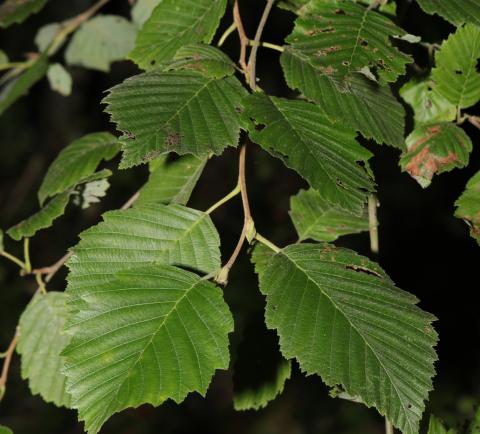
Alders can thrive in soils that are inhospitable to other plants.
Whether due to environmental changes, human-initiated uses, or some combination, the capacity for New Hampshire’s lands to sustain plant life is continually evolving. New Hampshire Agricultural Experiment Stations scientists at the University of New Hampshire are discovering new ways that land with harsh, inhospitable soils and environments across the Granite State could be stewarded toward healthier, more productive conditions that support the state’s forests, natural resources, and food systems. The key has been understanding the relationship between microbes and fungal communities in soils near “pioneer” plants, which are able to grow where other plants simply cannot.
Anyone who has battled weeds encroaching on driveways or patios knows that certain plants find a way to grow in unexpected places. Sometimes, however, environmental disruptions can be too harsh for just about any plant, such as in old landfills, strip mine or gravel pit sites, and areas where soil is salty or has been eroded. That’s where actinorhizal plants—plants including alders as well as bayberry, sweetfern, and others that partner with nitrogen-fixing bacteria—gain a competitive advantage. For example, after Mount St. Helens erupted the first plants to repopulate the devastated countryside were actinorhizal, providing the natural first step toward restoration.
“It’s imperative to understand how the pioneer plants’ microbiomes change over time at different locations and in relation to environmental disturbances and contaminants,” says Station scientist Louis S. Tisa, professor of microbiology and genetics in the department of molecular, cellular, and biomedical sciences. “That knowledge will provide the foundation for successful and lasting partner-planting and bioremediation efforts at ecologically damaged sites like landfills, or even the 22 superfund sites in New Hampshire.”
Pioneer plants such as alders (Alnus rugosa) often play vital roles in land reclamation projects. To better understand why, Tisa and Alexandra Gomez ’G27, a doctoral candidate in microbiology in the UNH College of Life Sciences and Agriculture, studied microbial characteristics in bacterial and fungal communities within alder root nodules, immediately next to the roots, and in the surrounding soil across six different New Hampshire sites during every season of a three-year research period.
In a paper chosen as an Editor’s Pick in Applied and Environmental Microbiology, Gomez and Tisa showed that the root nodule and soil microbiomes vary in different locations—from pristine rural freshwater wetland site to those located near major roadways and subject to vehicular exhaust and contaminant runoff—underscoring the importance of understanding environmental and soil variables for land reclamation.
While not as inhospitable as some environments, New Hampshire roadside soils are exposed to salt, metals, water-soluble chemicals from asphalt, exhaust byproducts, and other contaminants. Of the six sites studied, five were near roadways but differing in other respects. The sixth site, in Candia, was rural, near to freshwater peatlands and far from any roadways. In addition to proximity to a roadway, the Hampton site was next to a saltwater marsh, the Durham site was close to a freshwater wetland, the Epping site was urban, the Durham-adjacent site was wooded, and the Raymond site was near a highway but not water.
“Alex did a really good field study and picked the locations well,” says Tisa. “We were able to see interesting differences in the microbial populations among the sites, reflecting the different environmental conditions and seasonal variability.”
The study’s findings show that the microbial populations in and around the alder root nodules were different from site to site, and they also showed seasonal variation. The Candia site had the lowest overall bacterial diversity, perhaps because the high levels of aluminum and sulfur in the soil, typical for peatlands, selected for certain species. The nitrogen-fixing bacterium Frankia also dominated the bacterial populations within the Candia alders’ root nodules. At the roadside sites, high levels of soil zinc strongly shaped the microbial communities. The relative amount of Frankia varied between the roadside sites, with the Epping and Hampton sites having the highest relative nodule occupancy.
Another important factor shaping the microbial populations was soil moisture, as the three sites with the most Frankia had more consistent water sources than the Raymond and Durham sites. Drought also played a role in one of the years. Typically, Frankia relative abundance peaks with high summer photosynthesis rates, but a spring and summer drought in 2022 pushed peak abundance from July to October region-wide. Nitrogen fixation within the root nodules and alder viability may therefore be limited in areas with insufficient soil moisture.
The project was supported by the NHAES through joint funding of the National Institute of Food and Agriculture, the U.S. Department of Agriculture, and the state of New Hampshire, USDA National Institute of Food and Agriculture Hatch 7002422.