
Scientists Study Safer, More Targeted Control for Costly Parasites
Though we seldom see them, nematodes, also known as roundworms, are just about everywhere in the environment. In fact, scientists estimate that for every person on earth, there are about 60 billion nematodes. Parasitic nematodes impact humans directly, with approximately 3.5 billion people affected globally, as well as through disruption of food and natural systems, damaging more than $100 billion in crops annually. New Hampshire Agricultural Experiment Station researchers at the University of New Hampshire are investigating a metabolic pathway that could impair nematodes’ viability and reproduction. Their findings indicate that disrupting the pathway offers a promising way to control specific parasitic nematodes, with lower environmental consequences than existing chemical-based approaches.

In addition to damaging crops, nematodes cause beech leaf disease, a growing threat for northern forests.
The Granite State’s cool, wet climate is conducive to many parasitic nematodes. Some are even airborne. Scientists think that beech leaf disease was brought to New Hampshire in 2022 from the west by a nematode new to the area, spread by the wind. The disease is now severely impacting beech trees throughout the state. The northern root-knot nematode lives in the soil, feeding on roots and impairing their ability to transport water and nutrients for a wide variety of valuable crops. New Hampshire producers of tomatoes, bell peppers, carrots, and onions often rely on chemical control methods, which are difficult, expensive, and can be environmentally harmful.
Working with Caenorhabditis elegans, a nematode species commonly used in biological and biomedical research, Station scientists Rick Cote and Kranti Galande employed multiple methods to test whether more effective and targeted approaches could lead to alternative management solutions. The scientists focused on inhibiting the activity of a family of proteins known as phosphodiesterases (PDEs). PDEs are vital for regulating the levels and activity of signaling molecules that nematodes need for proper function.
“Current plant-parasitic nematode management involves very toxic compounds that can harm animals, plants, and the workers spraying them, so their use is strictly limited,” says Cote, professor in the department of molecular, cellular, and biomedical sciences. “We looked for a PDE that disrupts the nematode life cycle when the PDE is inhibited or completely eliminated. The ultimate goal is to develop nematicides that target parasitic nematodes without harming other organisms in the environment.”
Hitting multiple targets
Humans and other mammals have 11 PDE families, and they are highly conserved, meaning they are essential and are found throughout the animal kingdom. PDE inhibitors are commonly used in human medicine to reduce inflammation and to treat cardiovascular disorders by relaxing smooth muscle and allowing freer blood flow through blood vessels. Nematodes have genes that are very similar to six of the mammalian PDE families, and Cote and Galande targeted them for the study.
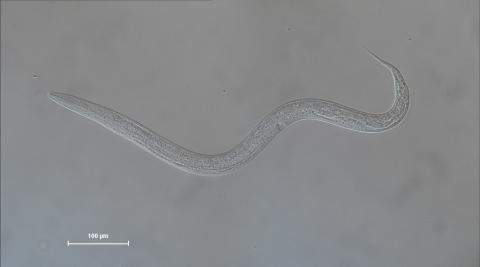
Caenorhabditis elegans is a small (1 mm in length) nematode commonly used in research.
Galande, a postdoctoral associate with Cote, spearheaded the project in the lab and developed the necessary molecular and analytical protocols. She inhibited or eliminated the function of each of the six PDE genes in C. elegans in multiple ways: by applying human PDE inhibitor drugs, by eliminating (‘knocking out’) each PDE gene one at a time with genetic editing, and by using RNA interference to silence PDE genes. She then screened each knockout strain for various physiological characteristics, including their viability, ability to reproduce, or move toward attractants.
“We were surprised to find that when we knocked out each individual PDE, none of the mutant C. elegans showed major defects in development or reproductive success,” says Galande. “Our PDE1 knock-out strain disrupted their ability to locomote to selected compounds, but otherwise all of the knockout strains seemed normal.”
If losing one PDE gene did little or nothing, what would losing two do? After some exhaustive work to create double gene knockout strains and to combine knockout strains with PDE inhibitors, the team found that certain combinations did indeed have the anticipated effects. One combination of knockouts and inhibitors—PDE1/PDE3 knockout worms exposed to a PDE4 inhibitor—reduced reproduction by four-fold and decreased overall activity. And knocking out PDE2 and PDE3 together proved to be lethal, with no nematodes surviving long enough to reach reproductive age.
“Kranti’s research revealed that a ‘cocktail’ of PDE inhibitors targeting multiple PDEs may provide a very effective way to manage plant-parasitic nematodes and improve agricultural productivity,” says Cote. “Also, the inhibitors we used were developed for human PDEs. Because the inhibitor binding sites in nematodes likely differ from those in human PDEs, designing novel compounds that specifically target nematode PDEs is likely to make them even safer and more targeted.”
The next step is testing whether PDE-targeted interventions can be successfully applied to plant-parasitic nematode control, an outcome that would have wide and economically impactful applications in food production and natural resource management. Targeted nematode-specific PDE inhibitors also have exciting potential for treating human and animal parasitic nematode diseases.