
What Makes a Walk in the Woods Good for Your Mental Health? UNH Research Offers New Clues
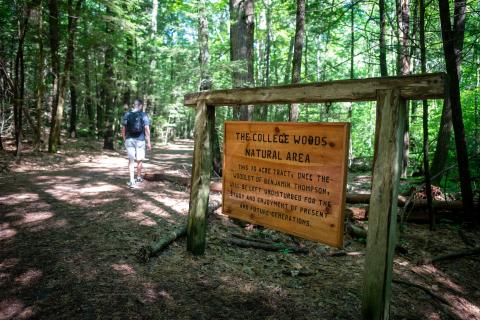
UNH researchers studied visitors to College Woods to better understand how perceptions of biodiversity and natural sounds relate to mental well-being.
Ever wonder why a walk through College Woods after spending hours studying can do wonders for your mood?
While past research has shown that spending time outdoors can improve mental well-being, new UNH research offers a closer look at what makes those experiences so beneficial.
In a yearlong study at College Woods, researchers found that visitors' perceptions of biodiversity — the many species living in the woods — and the sounds they experienced were closely linked to mental well-being. They also found that something as simple as an educational sign highlighting biodiversity could give visitors' moods an additional boost.
The study, published in Landscape and Urban Planning, was led by an interdisciplinary team that included Lauren Ferguson, assistant professor of recreation management and policy, Remington Moll, associate professor of natural resources and the environment, Laura Kloepper, associate professor of biological sciences, UNH graduate student Anna Frisbie, and Karina Sanchez, assistant professor of biology from California State University, Dominguez Hills.
“Previous nature-health research had a major limitation: it could tell us that ‘biodiversity is good for mental health’ but couldn't tell land managers, park planners, or healthcare providers what to actually do with that information,” Ferguson says. “The research lacked specificity about which aspects of biodiversity matter most and how to enhance the mental health benefits of nature visits.”
Digging Deeper into the Benefits of Nature
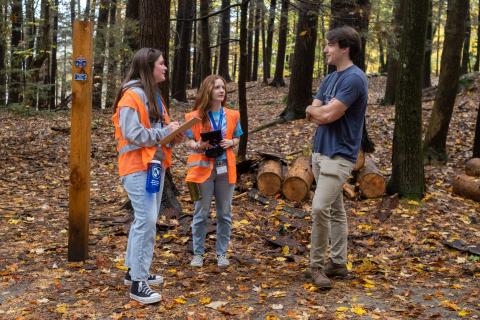
Between June 2023 and May 2024, researchers surveyed visitors to College Woods, a 230-acre natural area bordering the UNH campus, collecting 641 matched surveys before and after their visits. They also measured biodiversity using wildlife cameras, bird surveys, and vegetation records.
Visitors reported more positive emotions, fewer negative emotions, and greater feelings of restoration, including relaxation and recovery from mental fatigue, after spending time in the woods. On average, participants' self-reported restoration scores increased by nearly 30% following their visits.
Additionally, researchers found that visitors' overall perceptions of biodiversity were stronger predictors of mental well-being than the actual number of bird and mammal species researchers measured. The pleasantness of the sounds visitors experienced, such as birdsong, rustling leaves, and flowing water, was another strong predictor.
The study also found that season influenced visitors' experiences. Participants reported greater feelings of restoration during spring and summer, but improvements in mood were observed regardless of season.
“I was somewhat surprised by these findings; however, I've had similar results in another project,” Ferguson says. “I think that visitors to parks are more comfortable perceiving overall biodiversity and forest health and perhaps less comfortable identifying and counting specific species. This is something that we will continue to examine in future research.”
The Impact of Signage
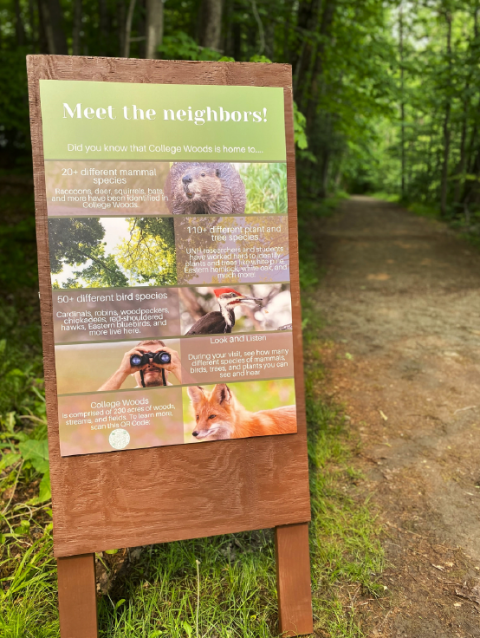
To explore whether helping visitors recognize biodiversity could influence their experiences, the researchers placed an educational sign near the College Woods trail entrance during designated periods and removed it during others.
The sign, titled "Meet the neighbors!" highlighted the forest's wildlife, including more than 20 mammal species, 50 bird species, and 110 plant and tree species. It encouraged visitors to look and listen for different species.
Visitors who encountered the sign perceived slightly greater biodiversity than those who didn't. The sign was also positively associated with positive mood, although it did not show a meaningful relationship with reductions in negative emotions or increased restoration.
“We think the signs may help people become more aware of the biodiversity around them and notice species they might otherwise miss,” Ferguson says. “That can create a stronger, more mindful connection with nature and turn a casual walk in the woods into a more restorative experience.”

Lauren Ferguson
Why This Research Matters
By shedding light on what makes time in nature beneficial, the findings offer insights for park managers, urban planners, and others responsible for maintaining public green space.
“Our research shows that educational signs about biodiversity were linked to a boost in positive mood during forest visits,” Ferguson says. “Biodiversity education signs are a simple, inexpensive tool that forest managers can use to enhance those benefits.”
For a university campus, where students often face academic pressures and mental-health challenges, the findings also underscore the potential value of accessible natural spaces such as College Woods, Ferguson adds.
“I hope that people start to view small community forests like College Woods and other parks as more than just a space for recreation, but as critical health infrastructure,” Ferguson says.
While the findings are specific to College Woods, where most participants were repeat visitors and many were connected to the university, Ferguson sees opportunities to build on the research. Future studies could explore whether similar results hold in other natural settings, incorporate physiological measures of well-being, and examine how different types of educational signage influence visitors' experiences.
This project was funded by the University of New Hampshire Agricultural Experiment Station through joint funding from the USDA National Institute of Food and Agriculture.