
What can you do with sustainability? One alum’s journey led to graduate research on the state’s forest health
Justin Wentworth ’26, who graduated with a dual degree in environmental sciences and sustainability, never dreamed he’d go to Cambodia. Added to the International Changemaker Grant student team just weeks before the trip, he said yes anyway, and it became a defining moment of his UNH experience. Now a graduate researcher at UNH, Justin is studying New Hampshire forest health through remote sensing. He reflects on the sustainability programs, campus experiences, and unexpected opportunities that shaped his journey.
What is the International Changemaker Grant?
Why did you choose UNH?
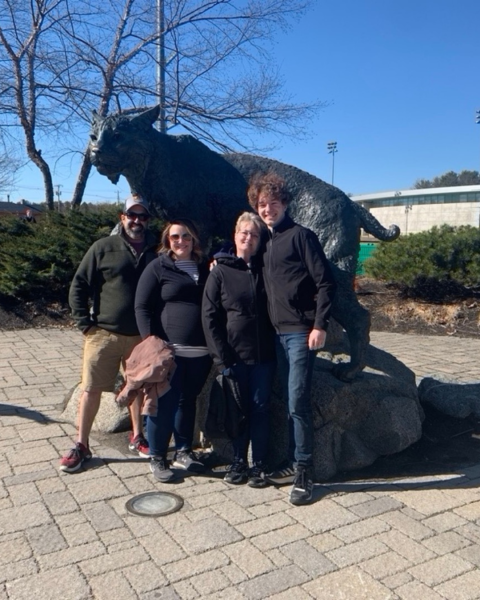
UNH grabbed my attention for its strong sustainability programming and campus living, as well as its natural resource programs and strong sense of community. I valued all of these things individually, but accumulatively, I could see my next steps in growth playing out in front of me. All on a packed campus that felt huge coming from my small town!
What got you interested in sustainability?
In high school, my Environmental Sciences teacher and mentor Mrs. Howry pulled me into my focus area in and out of class, encouraging me to check out our sustainability club (that she helped run). The Society of Sustainable Spartans, or SOSS, laid the groundwork of my morals, values, and passion for protecting our planet. As a club we achieved successes I am forever fond of, such as upgrading our school's lighting system to LED's using funding from USDA. I knew I wanted to continue this path post high school and made this the core of my college search and how I spent my four-years at UNH.
What were your most impactful undergrad experiences?
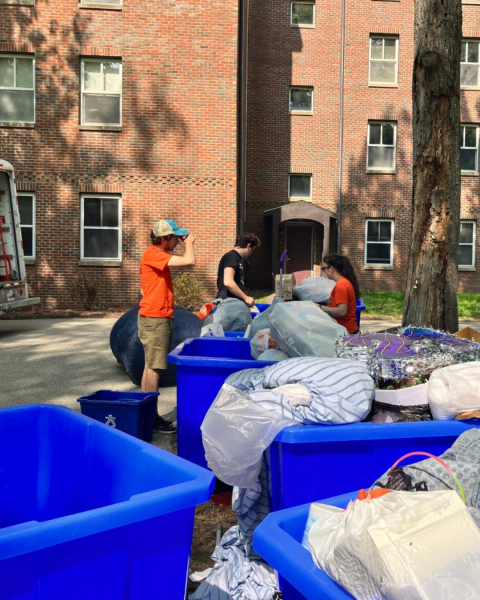
In no particular order, my three most impactful experiences as an undergraduate at UNH were 1) my GIS capstone assessing water quality across India, 2) helping lead the Trash 2 Treasure program through the Sustainability Institute, and 3) my International Changemaker Grant trip to Cambodia.
Tell us more about your trip to Cambodia through the International Changemaker Grant.
My shoulder was tapped by a former group member when they had to drop out of the trip, and I didn't hesitate to find out more! The rest of the group found time to talk to me the very next day and I couldn't say no.
The goal of the sustainability project directly connected with my own academic and research interests, giving me opportunity to display what I already know but even more so learn from fantastic peers and international professionals alike. I was beyond honored to join!
How did that experience impact you?
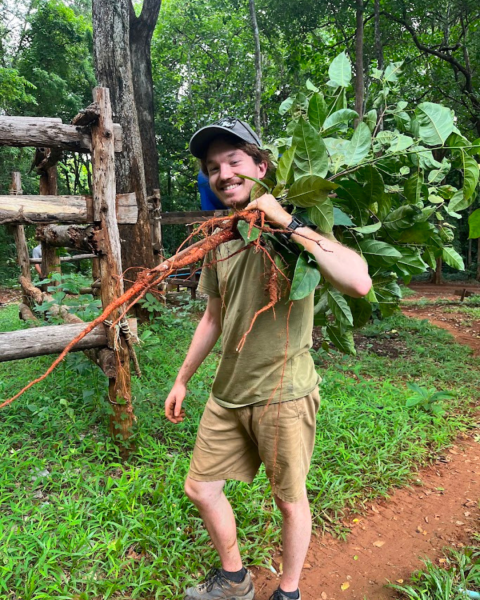
This experience brought me a wave of growth. Professionally, I gained experience with various Geospatial Analysis tools, some I hadn't worked with before, and gave me experience not only presenting but teaching.
This experience was the most direct, hands-on, out of the classroom opportunity related to environmental sciences, conservation work, and sustainability initiatives as an undergrad.
It was my first trip outside of the country, or even on a plane! As such I was so radically moved by this trip. I feel more capable as an individual and more connected to our Earth. I was amazed by the culture of Cambodia and adored exploring Phnom Penh.
Your trip involved a team of students from different majors; what was that experience like?
Rewarding, intellectually and socially.
Much of my time at UNH was spent surrounded by other natural resources mindset and methodology, as well as other sustainability folks. These are my people, but experiencing a few new lenses applied to an individual goal and project broadened my understanding.
Particularly, how the coding / computer sciences, as well as humanitarian / social sciences can overlay geospatial analysis work.
What should prospective students know about the International Changemaker Grant?
I think the most unique perspective I can offer is my timeline of involvement in the project. I was added in very late, a reason to give a shout out and gratitude to my group members, who deserve most if not all of the credit, but it didn't dissuade their interest in me joining. I was about to graduate and would almost a month before the trip. I still went; it wasn't an issue. This is no small undertaking, but this is not the same as adding a 5th (or 6th) class to your course schedule. This is not taking on a part-time job. This is not committing to a semester abroad.
If you have an interest at all, do not hesitate to try and fit this in. You won't regret it. This felt like the most fun, bonus cherry-on-top to my college experience.
What are you doing now?
My graduate research is with the Basic and Applied Spatial Analysis Lab (BASAL) under Dr. Benjamin Fraser applying remote sensing tools to advance our state-level detection, tracking, and mitigation of forest pests like Emerald Ash Borer and Beech Leaf Disease. Our work will largely involve drone and satellite imagery, assessing forest health characteristics as well as effectiveness of current treatment plots for forest pests. New remote sensing methods have emerged, other projects have revealed successes and next steps with certain pests, and new technologies have become more efficient and/or readily available for industry and consumer use. At the same time, certain legislature changes have begun to reduce some options, creating extra navigational hurdles. We are charting a path forward in collaboration with the New Hampshire Agricultural Experimental Station to comply with new restrictions, test new methods, improve classification accuracies, and contribute to the larger interstate efforts to protect our forests from invasive pests.
Where do you see yourself in a few years?
I am currently fully immersed with the geospatial analysis world, as you might expect given my research. For the next 2 years I know that my focus will be on my research, but I wouldn't have started into this next chapter without feeling a sense of calling and purpose to this field. It combines all of my academic and intellectual interests and allows me to fully "nerd out" regularly. It makes me understand and "trust the process" more and makes me wish I had somehow seen this pathway sooner. While that's out of my control, I hope to learn all I can in this field during my master's to guide my future, whether that is staying in academia or venturing outside of Durham to do similar work with state agencies or otherwise. I love this field so far!