
Watching Our Waters
The organisms comprising plankton, which can be smaller than the width of a human hair, form the base of the marine food chain and supply as much as 50% of the total oxygen in the atmosphere. Across the Gulf of Maine and at sites near the New Hampshire coast, Elizabeth Harvey, associate professor and biological sciences department chair at the UNH College of Life Sciences and Agriculture, focuses on changes in phytoplankton and what those changes may mean for the health of oceans, marine life, and even humans.
“We have sampled phytoplankton communities at different locations in coastal New Hampshire weekly since 2020,” says Harvey. “We can now detect changes from the usual cycles and better evaluate what might be driving those changes.”
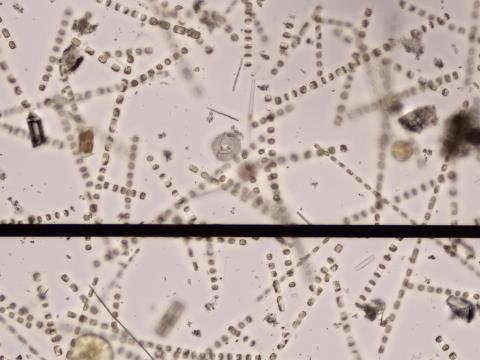
The numbers of a particular species of phytoplankton can rapidly increase, creating what are known as blooms. While blooms of many plankton species have little short-term effect on the environment, others can be toxic to shellfish and other marine organisms, and some can harm people, such as the widely known “red tide” — a dangerous algal bloom that occurs frequently along the coast of Florida.
Harvey was on-site for a large bloom of brown algae in 2023, since documented in a paper published in the Journal of Plankton Research. Harvey recently discussed her observations of what is happening off the coast of New Hampshire and what it might mean.
Q: The Gulf of Maine is warming faster than almost any other ocean surface on the planet. With the warming conditions, why do you think the last couple of years lacked any big blooms?
Harvey: There were record high water temperatures in the Gulf of Maine for many years in a row until 2023, but the last two years have been cooler, with lower salinity. The relative influence of the warm Gulf Stream and cold Labrador current play important roles in how warm the Gulf of Maine gets. Could the increase in cooler water temperatures suppress blooms in the past few years? We can speculate, but the causes and effects remain unclear.
Q: But after a quiet period, this summer had another bloom that made the headlines. Is it the same species of phytoplankton as three years ago?
Harvey: No, but both are dinoflagellates, a large group of aquatic one-celled organisms often referred to as algae. The 2023 bloom was made up of Tripos muelleri, while this year’s is Karenia mikimotoi. Neither species produces toxins that are dangerous to humans, but both are important to monitor, as they can harm shellfish and finfish if the bloom is intense enough.
Q: Have you seen any other events that might be of concern lately?
Harvey: In Great Bay in recent years we’ve seen intense blooms of diatoms, another common type of phytoplankton, during December and January rather than the more typical early March to early April time span. We’re curious about what’s going on there — has something changed in the environment that has shifted the blooms to the middle of winter?
Q: Why is the timing of the bloom important?
Harvey: Diatoms are a very important food source for many marine animals, including oysters. If they bloom in the winter, when oysters are dormant, and not in the spring, when oysters need more energy, will that affect oyster viability or growth? We’re working with [COLSA researchers] Easton White and Brittany Jellison to see just how completely oysters shut down during winter dormancy and whether the changing phytoplankton conditions might have consequences.
Q: Why do you sample the phytoplankton so regularly?
Harvey: The [data collected over many periods called a] time series has been mostly a labor of love — it hasn’t been well supported by funding — but we’re establishing an extremely important baseline, a kind of microbial herbarium. If we characterize what’s there and know which species are present in what ratios at what times, we also know when things diverge from that baseline. In a changing environment, it’s essential to be able to identify disruptions and deal with the ecological issues that emerge.
Q: What’s next in your research and what are the issues that you are keeping an eye on?
Harvey: We are continuing our weekly sampling and expanding into sampling freshwater communities in rivers that flow into Great Bay. We are pursuing a variety of questions including looking for the presence of existing or emerging microbial pathogens that may impact aquatic life, and also very interested in continuing to characterize the winter blooms that have been happening over the last several years. The lab is excited to continue to be responsive to bloom events happening in the Gulf of Maine.