
Professor Kristen Johnson Receives National Innovation in Education Award
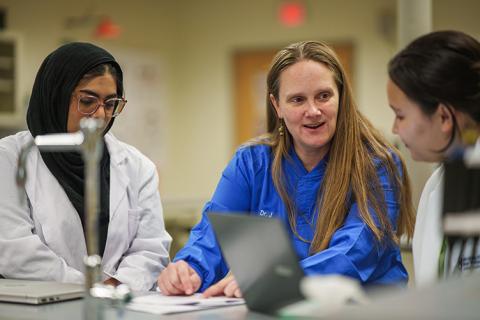
Kristen Johnson.
Kristen Johnson, associate professor of biotechnology at the University of New Hampshire at Manchester, has received the American Society for Cell Biology’s (ASCB) 2026 Innovation in Education Award for her innovative approaches to science education and commitment to expanding research and professional development opportunities for students.
Johnson was selected by an ASCB committee for her impact spanning classroom instruction, undergraduate research, industry partnerships, and national initiatives designed to make scientific learning more accessible.
For Johnson, innovation in education begins with a simple idea: Students learn best when they have opportunities to experiment, make mistakes, and discover answers for themselves.
That philosophy has shaped her teaching style at UNH Manchester, where she has developed research-based courses that give students hands-on experience with scientific inquiry. Rather than following prescribed experiments with predictable results, students design their own investigations, develop hypotheses, analyze data, and present their findings.
Johnson has developed four distinct course-based research experiences spanning molecular biology, protein biochemistry, and cell culture. These experiences have become an integral part of the life sciences curriculum, with most students now completing at least one research-based course during their degree programs.
In one molecular biology course, students previously used synthetic biology to create programmable biosensors. Today, they use freshwater flatworms to investigate human diseases. In the cell culture course, they investigate how drugs affect fat cell development to better understand metabolic diseases. These projects expose students to the challenges and discoveries of scientific research while helping them build problem-solving, collaboration, and communication skills.
Johnson’s impact extends beyond the classroom. Over the past nine years, she has mentored more than 90 student researchers in her laboratory, which investigates the molecular mechanisms of pancreatic cancer and other diseases. Her approach has helped students contribute to published research, present scientific findings, and pursue advanced degrees.
Johnson has also worked to expand access to biotechnology career opportunities through NH CLIMBS (Collaborative Learning through Industry Internships and Academic Mentorship in Biotech for Students), a program she developed to connect students with industry-relevant research and technologies. The initiative provided paid, hands-on research opportunities that allowed students to collaborate with biotechnology companies without having to leave campus for traditional internships.
Building on this commitment to accessible, industry-relevant training, Johnson also organized summer Cell Culture Crash Course workshops for New Hampshire students whose institutions lacked access to advanced laboratory coursework. Supported by funding from NH INBRE and EPSCoR, the workshops combined technical training with industry visits, professional networking, and financial support for participants.
Together, these initiatives helped reduce geographic and financial barriers to valuable research and training experiences, preparing students for opportunities in the biotechnology industry.
Beyond UNH Manchester, Johnson serves as a co-principal investigator of the National Science Foundation-funded Cell Biology Education Consortium, a national initiative that helps faculty and undergraduate students publish their scientific research. Through mentorship, editorial support, and professional development programs, the consortium has supported more than 10 publications over the past two years.
These efforts reflect Johnson's commitment to making meaningful scientific experiences available to students from a wide range of backgrounds, while preparing them for careers and further study in the life sciences.
Johnson will be recognized at ASCB's annual Cell Bio meeting in San Diego this December, where she will deliver a presentation titled Innovation in Education: Why Uncertainty Is the Starting Point, Not the Obstacle.
Drawing on her own experiences as a first-generation college student, Johnson's presentation will explore how embracing uncertainty, taking risks, and learning through trial and error can lead to more effective teaching and meaningful educational change.
"Rather than viewing imperfection as something to overcome, I argue that it is the foundation of creativity, resilience, and lasting growth," Johnson writes in her presentation abstract.
It's a perspective that continues to guide her work at UNH Manchester: creating opportunities for students not simply to learn about science, but to experience the process of discovery firsthand.